
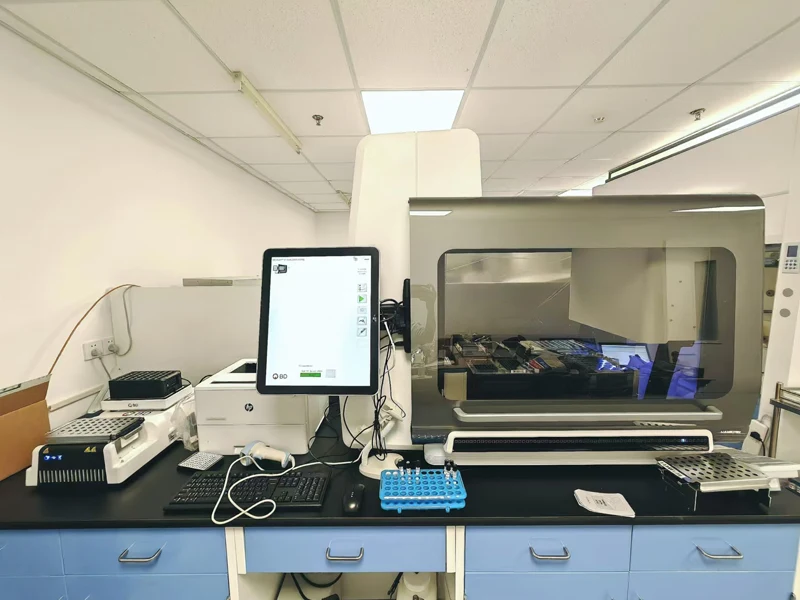
The Viper LT™ System combined with the Onclarity™ HPV Assay delivers comprehensive individual genotyping results for all 14 high-risk HPV types from a single specimen — targeting E6/E7 oncogenes for maximised sensitivity and enabling personalised cervical cancer risk stratification in a fully automated walk-away platform.
Human Papillomavirus (HPV) infection is the primary causative factor in virtually all cases of cervical cancer. Persistent infection with high-risk HPV genotypes — particularly HPV 16 and 18 — is associated with the highest risk of progression to cervical intraepithelial neoplasia (CIN) and invasive carcinoma. The ability to identify specific HPV genotypes, rather than simply detecting the presence of any high-risk HPV, represents a major clinical advance in risk stratification and patient management.
Onclarity™ HPV Assay: Extended Genotyping
Unlike conventional HPV assays that provide a binary positive/negative result for a pooled panel of high-risk types, the Onclarity™ HPV Assay delivers individual genotyping results for six types with the highest oncogenic risk:
- Individual results for HPV 16, 18, 31, 45, 51 and 52
- Concurrent pooled detection for HPV 33/58, 56/59/66 and 35/39/68
- Total coverage of all 14 IARC-classified high-risk HPV genotypes
The assay targets the E6/E7 oncogene regions — the regions most directly associated with carcinogenic transformation — rather than the L1 gene targeted by many first-generation HPV assays. This targeting strategy maximises analytical sensitivity for clinically significant infections and reduces false-negative results from L1 region deletions that can occur in advanced CIN lesions.
Viper LT™ Automation Platform
The Viper LT™ System provides the automated liquid handling, nucleic acid extraction and real-time PCR detection infrastructure upon which the Onclarity™ assay runs. Key platform features include:
- Fully automated specimen processing from primary tube to reportable result
- Walk-away operation — minimal operator hands-on time after loading
- Batch processing capability for high-throughput laboratory environments
- Compatible with SurePath™ and other LBC media — enabling co-testing from a single collected specimen
- Integrated quality control monitoring with automatic flags for invalid or equivocal results
“Individual HPV genotyping — particularly the ability to distinguish HPV 16 from other high-risk types — is no longer a research luxury. It is a clinical necessity for personalised triage and risk-stratified management in women with abnormal cytology or positive primary HPV screening results.”
Clinical Significance of Extended Genotyping
The clinical value of individual HPV genotype identification extends across several key decision points in cervical cancer screening pathways:
- Primary screening: Women testing positive for HPV 16 or 18 can be triaged directly to colposcopy, while those positive for other genotypes may undergo reflex cytology assessment
- Post-treatment surveillance: Genotype-specific follow-up enables distinction between treatment failure and new infection with a different HPV type
- Risk stratification in ASC-US: HPV genotyping provides objective risk stratification to guide colposcopy referral decisions in women with equivocal cytology
- Population screening data: Genotype-level prevalence data supports public health monitoring of HPV vaccination programme effectiveness
Regulatory Approvals
The Onclarity™ HPV Assay has received FDA PMA approval for use in primary cervical cancer screening (with or without cytology co-testing) and for reflex testing in women with ASC-US cytology results. It is also registered with NMPA for use in clinical laboratories across China, enabling full commercial deployment in both public hospital and private laboratory settings.
Access and Distribution
Hong Kong Origins Investment Limited provides access to the Viper LT™ System and Onclarity™ HPV Assay across the Greater Bay Area through our established medical device trade network. We support healthcare institutions with regulatory compliance, logistics, installation and staff training.
To learn more about implementing HPV genotyping in your cervical cancer screening programme, please contact our specialists.